e premte, 22 qershor 2007

Teens Who Use Drugs Are Less Likely to Get in Fights

Pete Guither at DrugWarRant points out another amusing irony contained in ONDCP's new report Teens, Drugs, and Violence. The report emphasizes the connection between teen drug use and violence with this statistic:

Nearly one in six teens (17%) who got into serious fights at school or work in the past year report using drugs;

Always skeptical, Pete used his research skills to put these numbers in perspective:

…if you look at the 2007 Monitoring the Future report, you see that the percentages of any teens who used drugs in the past year are: 8th grade (14.8%), 10th grade (28.7%), and 12th grade (36.5%). So to say that 17% of teens who got into serious fights report using drugs is not a particularly alarming thing. (In fact, it appears by these numbers that teens who use drugs are actually less likely to get into serious fights.)

It might be necessary to explain that Monitoring the Future is government data, frequently cited by ONDCP when it suits their agenda. Of course, we wouldn't go around issuing reports about how drug users are less violent than everybody else (even though that seems likely to be true). The point here is that ONDCP's insinuations about the relationship between drug use and youth violence reflect the precise opposite of what the data actually show. And this predictably proves to be the case virtually every time a report such as this is issued by that office.

One need only examine the sprawling media coverage they've generated this week to see why ONDCP has every incentive to continue issuing meaningless announcements like this as often as possible. Some news outlets did include a reform viewpoint, but that's insufficient since the headline does most of the damage and since the report's intellectual value is null to begin with.

A media that is dutifully skeptical of self-serving claims by government officials would quickly discover the treasure trove of nonsense and incoherence contained in every such announcement from ONDCP. Unfortunately, we don't have one of those. Therefore, journalists, I beg you, if you receive a press release that begins, "John P. Walters, Director of National Drug Control Policy, today released a new Special Report showing that..." please understand that there are almost certainly several potent ironies and contradictions contained therein, which deserve to be noted in your reporting. If necessary, I will point them out to you with or without being credited.

Otherwise, understand that if you publish a story merely passing along claims made by the Office of National Drug Control Policy, the likelihood that you've authored something inaccurate, incorrect, and/or incomplete will be extraordinarily high.

Ton of marijuana catches fire in warehouse

DINBURG - Federal authorities were trying to find out Thursday who stored 2,000 pounds of marijuana in a warehouse that caught fire.

It took more than 35 firefighters about half an hour to extinguish Wednesday's blaze with 1,000 gallons of water and five gallons of chemical suppressant, Edinburg Fire Chief Shawn Snider said.

Snider said the firefighters were exposed to so much marijuana smoke they would not be able to pass a drug test, despite the air packs they wore to prevent them from inhaling toxic or hazardous fumes.

U.S. Immigration and Customs Enforcement agents were called in to investigate the origin of the drugs, and the Hidalgo County fire marshal was investigating whether arson may have been the cause.

Connecticut Governor Vetoes Medical Marijuana Bill

Studies conflict on how effective the treatment is.

Connecticut Gov. M. Jodi Rell has vetoed legislation to make medical marijuana legal. She said the bill was fraught with problems and sent the wrong message to kids. Rell, a cancer survivor, said she struggled with the decision, one that many states are facing.

Medical marijuana is touted as offering relief from the nausea caused by chemotherapy and chronic pain. The bill’s sponsor, state Rep. Penny Bacchiachi, said she gave her dying husband marijuana 20 years ago.

“The people who are trying to use it as medicine and want to follow a framework, they don’t want their loved ones out there buying things on the street and getting arrested … those people are affected by the lack of having this bill," she told Family News in Focus.

But Dr. Jim Small with the Christian Medical Association said there’s no need for the legislation.

“Marijuana is actually available in tablet form as a legal prescription drug," he said. "It’s called Marinol, and so there’s probably not much reason to allow it to be smoked.”

So why are some lawmakers still pushing for legalization?

"I suspect some percentage of the people who are pushing for this see it as a step toward full legalization of marijuana," Small said.

Eleven states have adopted medical marijuana laws since 1996 — most by a vote of the people.

Huge Veto Override Comes as Congress Prepares to Consider Medical Marijuana

BBSNews 2007-06-21 -- (MPP) PROVIDENCE, RHODE ISLAND -- With the U.S. House of Representatives expected to consider a medical marijuana amendment within weeks, Rhode Island legislators have resoundingly overridden a gubernatorial veto to make that state's medical marijuana law permanent. Today's 58-11 House vote follows a 29-4 Senate vote to override on Wednesday.

Rhode Island's original medical marijuana law - also passed over a veto by Gov. Donald Carcieri (R) - had a one-year sunset clause, and was due to expire June 30.

"The fact that this override passed by an even larger margin than the original override last year says everything you need to know about how well the law has worked, and how completely uncontroversial it's been," said Ray Warren, director of state policies for the Marijuana Policy Project in Washington, D.C.

"Thanks to this law, I have safe and legal access to my medicine, and I'm relieved that it's going to be permanent," said Bobby Ebert of Warwick, who uses medical marijuana to treat symptoms of AIDS.

"Our legislature has stood with the scientific and medical community to ensure that I and hundreds of other seriously ill Rhode Islanders don't have to live in fear," said Rhonda O'Donnell, R.N., a multiple sclerosis patient who was the first to sign up for Rhode Island's program. "But the job won't be finished until every patient in every state who needs medical marijuana has complete protection. It's time for every state legislature and the U.S. Congress to change cruel and unscientific laws that criminalize the sick."

The override heartened medical marijuana supporters in Washington, D.C., where the House of Representatives will soon vote on an amendment to bar the U.S. Department of Justice from interfering with state medical marijuana laws. "This vote helps show members of Congress that medical marijuana simply is no longer controversial, and not an issue they need to fear supporting," said MPP director of government relations Aaron Houston.

Man arrested with pot behind his ear

PALM BEACH, Fla., June 22 (UPI) -- An Illinois man was arrested on drug charges in Florida after a police officer he asked for directions spotted a marijuana blunt behind his ear.

Maurice Stuckey, 20, of Dolton, Ill., was arrested on a charge of marijuana possession in Port St. Lucie, Fla., The Palm Beach Post said Thursday.

Police said Stuckey admitted that the blunt -- a cigar that has been hollowed out -- contained marijuana. Police also said they found five grams of marijuana in a search of Stuckey's car.

He was released on $500 bond.

e enjte, 21 qershor 2007

Free speech goes up in smoke at school

From Wednesday's Globe and Mail

WINNIPEG — It started months ago when Kieran King's high-school class heard a presentation about the dangers of drug use.

Kieran, a 15-year-old Grade 10 student in tiny Wawota, Sask., population 600, thought the presentation lacked credibility, so he did some research on the relative health risks of alcohol, tobacco and cannabis.

When he told some of his fellow students that cannabis seemed the least hazardous of the three, he set in motion a series of events that led to a school lockdown, a threat assessment involving the RCMP, a suspension and failing grades on his exams.

"It's all a bit overwhelming," his mother, Jo Anne Euler, said. "It's just totally bizarre."

She explained that her son is a compulsive researcher who tends to go on at length about what he reads on the Internet.

One student at Wawota Parkland School didn't want to hear Kieran's thoughts about marijuana, and complained to principal Susan Wilson.

The principal then called Kieran's mother because she was concerned he was advocating drug use, Ms. Euler said.

Ms. Euler told the principal her son is an A student who doesn't go out, doesn't smoke or drink, and isn't pushing drugs on other kids.

"She said 'Well, if he talks about it again, I will be calling the police,' " Ms. Euler said. "I told Kieran that and he said 'Mom, all I'm doing is sharing the facts.' "

Kieran felt his right to free speech was being trampled, so he enlisted the help of the Saskatchewan Marijuana Party.

Together they planned a school walkout for free speech, scheduled for 11 a.m. last Tuesday, where free chocolate chip hemp seed cookies would be handed out.

But just before 11 that day, the principal announced that the school was a closed campus and that no one was allowed outside.

When several students tried to leave anyway, teachers barred the doors and ordered them back to class, Ms. Euler said. Kieran and his younger brother Lucas defied and joined a ragtag group of five protesters standing across from the school holding placards.

The principal then ordered a lockdown to ensure the safety of students. The RCMP raced to the scene, only to find a small, peaceful protest.

Kieran's mother was again called to the school and told that both her sons had been suspended for three days. Later that day, the school conducted a threat assessment on Kieran with the help of the RCMP and school division counsellors, Ms. Euler said.

"In the letter I got about the threat assessment [the principal] had documented five or six times in the last year that Kieran had talked to some kid about marijuana - not one of those times was Kieran ever talked to or was I ever talked to. Were they documented before or was it a witch hunt after the fact where they said 'Let's try to remember all the times Kieran talked about marijuana?' "

Don Rempel, director of education in the South East Cornerstone School Division, said the principal acted appropriately.

"The school had received complaints that the student was promoting the use of marijuana as an alternative to alcohol or sharing information around marijuana use," Mr. Rempel said, adding that Kieran overreacted to the principal's simple request.

Kieran is now in Shanghai where he will spend the summer learning Mandarin and working as an English tutor. He had scheduled his exams early in order to accommodate his trip, but the suspension meant he couldn't attend school to write the exams. As a result, he got a mark of zero on each paper. His marks were high enough to pass, but instead of getting 85 or 90, he'll get 55 or 60, his mother said, which could hurt his chances of a university scholarship.

She is appealing to the school board to allow Kieran to write his exams in September.

Serious Illness Can Use Marijuana?

Connecticut's governor, a cancer survivor, vetoed a bill that would have allowed people with certain serious illnesses to use marijuana, saying it was fraught with problems and sent a mixed message to children.

Gov. M. Jodi Rell said Tuesday that she struggled with the decision.


"I am not unfamiliar with the incredible pain and heartbreak associated with battling cancer," the Republican said. Rell was diagnosed with breast cancer in 2004, a few months after taking office, and she underwent a mastectomy.

The bill she vetoed would have allowed people older than 18 with medical conditions such as cancer, multiple sclerosis and AIDS to grow and use four marijuana plants after getting written permission from a doctor and registering with the state.


The issue pits broader patients' rights against concerns of legalized access to an illicit drug. Twelve states let some patients use marijuana despite federal laws against it.
"I think this is a big step backward," said Republican state Rep. Penny Bacchiochi, a widow who risked arrest more than 20 years ago to obtain marijuana for her husband while he struggled with bone cancer.

TV talk show host Montel Williams, diagnosed with multiple sclerosis in 1999, lobbied at the state Capitol in support of the bill. He said he uses marijuana to help alleviate the pain and debilitating symptoms.

Copyright 2007 The Associated Press. All rights reserved. This material may not be published, broadcast, rewritten, or redistributed.

Medical Marijuana Vetoed By Connecticut Governor

Governor Jodi Rell vetoed legislation today that would have made it legal for some patients suffering severe, chronic pain to possess and grow small amounts of marijuana.

Governor Rell said that the bill "forces law-abiding citizens to seek out drug dealers to make a purchase and there is no provision for monitoring the use or proof of its effectiveness. Rell also said that the American Medical Association, National Multiple Sclerosis Society, American Glaucoma Society, American Academy of Opthamology, and American Cancer Society opposed using marijuana for medical purposes. Id.

I spent some time in the Connecticut capitol building as this bill was debated. Pamphlets were circulating the building from whitehousedrugpolicy.gov. One pamphlet says that " [s]imply put, the smoked form of marijuana is not considered modern medicine."

I also came across a circulating letter from Representative Toni Boucher, who opposed the measure. Her letter, which I do not know where to find on the internet, states that she

"first began work on this issue after a very emotional and tearful appeal from a mother and father who had found their handsome talented, young son dead from a drug overdose at home in his bed. They and countless others warned that this measure would be devastating to our state."

This is how medical marijuana is fought. Allusions to heartbreaking stories - but there is certainly no tie-in here to marijuana.

She also cites many studies that show "the facts are not there" to suggest marijuana has any effect on reducing pain.

Could this not be determined by the chronically suffering patient? If it didn't work, are we afraid then that these people would sell their supply?

She also contends that Yale and Connecticut medical societies have found marijuana to damage the brain, heart, immune system and lungs - among other things. "It also contains cancer causing compounds."

How about cigarettes?

A proponent of the bill, Penny Bacchiochi, stated in the article that "I don't see how we could pass the same bill in the same form while she is governor,". See above

I also came across a letter from Ms. Bacchiochi - short and to the point. She states in it that Massachusetts recently won a legal battle "to allow the University of Massachusetts to move forward with the cannabis research", after a proponent group sought to conduct federally funded studies. She also noted that much research has found marijuana to have palliative effects.

To visit Governor Rell's website, please go here. To see the bill text and so on, go here.

2 farmers suing DEA over right to grow hemp

Two North Dakota farmers who want to grow hemp are filing a federal lawsuit today to challenge the Drug Enforcement Administration's ban on the plant that is the same species that produces marijuana.

Hemp can be imported from Canada, Europe and China, but growing hemp in the USA is illegal, the DEA says.

"Hemp is marijuana," DEA spokesman Garrison Courtney says. "There's no distinguishing feature between marijuana and hemp."

Lawyers for the farmers say the Controlled Substances Act, which governs illegal drugs, makes a specific exception for hemp, a non-drug version of the marijuana plant. They are seeking a court ruling that says the federal authorities cannot arrest the North Dakota farmers for growing hemp.

The federal government used to encourage farmers to grow what is known as "industrial hemp," says attorney Joseph Sandler in Washington, D.C., who is representing the farmers. Hemp plants have a low concentration of the psychoactive chemical that gives marijuana users a high, he said.


"You can smoke 17 fields of this stuff, and it's not going to do anything," Sandler says. "It doesn't make sense to say you can import all this hemp, but you can't grow it and import it from North Dakota to South Dakota."

North Dakota's Legislature began considering allowing farmers to grow hemp more than 10 years ago after disease wiped out the wheat and barley crop, says state Rep. Dave Monson, a Republican leader in the Legislature and one of the farmers filing the lawsuit.

In 1993, the disease was so bad, "we actually burned every acre of wheat and barley we produced," says Monson, who lives in Osnabrock. "I came to the realization that we needed alternative crops."

Just across the North Dakota border, farmers in Canada are growing hemp and making a profit, he says. U.S. manufacturers who use hemp to produce textiles, soaps and other materials must import the crop from countries that allow hemp farming.

A North Dakota State University study in 1997 found a good market for hemp in the USA, so the Legislature passed laws to regulate hemp farming, Monson said. The laws require background checks on the farmers and monitoring to make sure illicit marijuana crops aren't growing in the middle of the hemp field, he says.

Agriculture Commissioner Roger Johnson issued the first permits on Feb. 6 to Monson and Wayne Hauge, a farmer and accountant in Ray, N.D. The farmers applied Feb. 12 for a DEA license, indicating they would need a decision by April 1 in time to plant the crop.

On March 27, DEA deputy administrator Joseph Rannazzisi in a letter to Johnson said it was unrealistic to expect a decision in seven weeks. That's where the plan stalled.

"I think it's pretty apparent that they are quite clearly choosing not to exercise their authority to distinguish between hemp and marijuana," says Johnson, who met with DEA officials in February.

"It's pointless to continue dealing with them," Johnson says. "Their inaction is a pretty clear indication that they're not taking the application process seriously. It's been an issue 10 years in the making."

Monson and Hauge say the time to plant the hemp has passed. Monson planted wheat in his field on June 1.

Courtney says the DEA is still reviewing the application and is concerned that the farmers will not be able to keep their fields secure. "We have to take a balanced approach to the application," he said. "We have to look at every aspect of the application. I don't think you can put a time frame on that sort of issue. It takes time."


Ex-cop sells pot tips on DVD


Now for the kicker: Cooper is a former narcotics officer once considered among the top cops in Texas, where more marijuana is seized each year than in any other state.

The formerly straight-laced lawman has become a shaggy-haired militant for the legalization of weed.

Six months ago he released "Never Get Busted Again," in which the former star of West Texas' Permian Basin Drug Task Force gives tips on hiding marijuana (dashboards are rife with nooks and crannies) and throwing off drug-sniffing dogs (coat your tires in fox urine).

"I'm not helping them to break the law. It's clear the law is already being broken," said Cooper, 38, who left law enforcement a decade ago. "I will do anything legal to frustrate law enforcement's efforts to place American citizens in jail for nonviolent drug offenses."

Law officers regard Cooper as a traitor. And some pro-pot activists say Cooper's antics actually undermine their cause.

"This is like waving red meat" in front of police, said Allen St. Pierre, executive director of the National Organization for the Reform of Marijuana Laws. "They take great professional umbrage with this. They are not our opposition, and we don't want to agitate them."

Federal drug agents said his tips won't keep them from finding your stash, and they advise drug users to save their $20 and use it to help post bail.

Richard Sanders, an agent with the U.S. Drug Enforcement Administration in Tyler, brushes off Cooper's DVD as a sham. "He's just out to make money," Sanders said.

Though he will not reveal how much he has made, Cooper said he has sold more than 10,000 copies of "Never Get Busted," primarily over the Internet and at a few smoke shops.

Defense attorneys have also called him as a witness to testify about unlawful tactics he says police use to make drug cases. For instance, he testified about how drug-sniffing dogs can be made to "false alert," which gives officers legal grounds to search a car or a home. Cooper said he has used that ploy himself.

Cooper has begun filming a second DVD, called "Never Get Raided." He said he is also planning a documentary in which he plans to ply 50 partygoers with beer and marijuana and film what happens next. The aim, he said, is to prove that partygoers who get high are less dangerous than those who get drunk.

Frederick Moss, a law professor at Southern Methodist University, said Cooper appears to be protected by the First Amendment and probably cannot be charged with conspiracy or aiding and abetting because he has no direct relationship with the customers he counsels in how to break the law.

Cooper claims that as a law officer, he took part in 800 drug busts, seized more than more than 50 vehicles and $500,000 in cash and assets, and made a case against a local politician's son.

"He was among the best we had," said Tom Finley, who was Cooper's supervisor on the drug task force. "I don't understand why he would turn like this."

Cooper has owned car dealerships, started a limousine service, dabbled as a cage fighting promoter and taught in a church. He lives in a pine-canopied hideaway in this East Texas town of 1,400, where his home includes a framed picture in the kitchen of Cooper holding a joint.

It is the same town where Cooper was last a police officer in 1998, when he said his frustration with small-town politics made him quit law enforcement and begin rethinking the war on drugs.

He filed for bankruptcy in 2005, blaming a tough divorce and the stock-market downturn after Sept. 11. He is also suing for $10 million over a 2005 raid of his home that Cooper alleges left bruises on his children — an incident he says convinced him police are hurting more families than they help. (Cooper says sheriff's deputies came to take his children away after his ex-wife complained he was not sending them to school or sharing custody.)

"My critics want to kill my credibility by claiming I'm doing this to make money and trying to keep any sincerity out of this," Cooper said. "The people who have seen me and know my work, they know I'm sincere."

Barry Cooper, an 8-year veteran of law enforcement and drug interdiction, with his web site in his offices in Tyler, Texas, on Thursday, December 21, 2006. Cooper is selling a DVD on his website titled Never Get Busted that he has produced with information on how law enforcement detects drugs being transported. (AP/Tyler Morning Telegraph, Tom Worner, File)
AP Photo: Barry Cooper, an 8-year veteran of law enforcement and drug interdiction, with his web site...

___

On the Net:

http://www.nevergetbusted.com

Volcano Vaporizer Review

Storz & Bickel, German inventors of the balloon system.

The first time I saw one of these bad boys, I was like, “What the fuck is that?” I was not very attracted to huffing on a balloonvolcano vaporizer with my drooling friends. In the pot clubs, I would see patients drooling on these things and passing them around. I thought, how medical is that? And then of course, I had to try one for myself. First of all, I had some kill. It was some of the best all year. I loaded up enough to roll a pretty thick doob for two. I cranked up the heat a little higher than the drooling patients did because I like to get good and stoned. I have to admit, this thing hits really fucking good and tastes awesome. It gave me the nose tingles, the whole bit. I was so stupid after hitting one of these. The downfall to this thing is that they over engineered the hell out of the thing. It has so many parts that it’s kinda fascinating but irritating at the same time. I spilled one load all over myself trying to change back from huffing mode to reload mode. Another great downfall is the price. If it were half the price I would own one. You have to be rolling like Snoop to afford one of these.

Rell Says 'No' to Marijuana

HARTFORD, Conn. (AP) -- Gov. M. Jodi Rell vetoed a bill Tuesday that would have legalized medicinal marijuana, acknowledging she struggled with the decision.

CLICK HERE and listen to Reporter Fran Schneidau

``I am not unfamiliar with the incredible pain and heartbreak associated with battling cancer,'' Rell, a Republican, wrote in her veto letter. ``I have spoken and met with dozens of people on this issue, all of whom have presented their positions passionately and articulately.''

But Rell, a cancer survivor, said she is concerned that the legislation sends the wrong message about drug use to Connecticut youth, and also does not spell out where patients and their caregivers would obtain marijuana plants.

``There are no pharmacies, storefronts or mail order catalogs where patients or caregivers can legally purchase marijuana plants and seeds,'' she said. ``I am troubled by the fact that, in essence, this bill forces law-abiding citizens to seek out drug dealers to make their marijuana purchases.''

Rell said she is also concerned that the bill is not limited to terminally ill patients.

The bill won final bipartisan legislative approval earlier this month, capping a five-year struggle that pitted broader patients' rights against concerns of easier access to an illicit drug. TV talk show host Montel Williams, diagnosed with multiple sclerosis in 1999, came to the state Capitol to urge support for the bill. He said he uses marijuana in various forms to help alleviate intense pain and debilitating symptoms.

The legislation would have allowed residents older than 18 with specific medical conditions diagnosed by a physician to cultivate and use marijuana to relieve the draining symptoms of diseases such as cancer and MS. Patients with written certification from their physicians would have to register with the Department of Consumer Protection.

Lorenzo Jones, executive director of A Better Way Foundation, a nonprofit organization that supported the legislation, said Tuesday he had not known Rell would veto the bill. The organization expected to issue a formal response later Tuesday, he said.

According to the national Marijuana Policy Project, 12 states allow patients to use marijuana despite federal laws against it. A
13th state, Maryland, protects patients from jail but not arrest.

Connecticut already has a medical marijuana law, one of the first in the nation. Under the 1981 law, a doctor can prescribe the illegal drug to relieve nausea associated with chemotherapy and eye pressure from glaucoma.

But the law is unworkable because, under federal law, physicians who prescribe marijuana can be sent to prison and risk having their medical licenses revoked.

Four arrested, thousands of pot plants seized

Washington County authorities arrested four people for allegedly growing marijuana at three different homes in Saint Paul Park.

Image

The big bust resulted in the seizure of more than 2,000 pot plants.

It began last Monday at 1335 3rd St., where authorities opened the door and found 365 marijuana plants.

Sheriff Steve Pott called it part of the biggest marijuana growing operation in recent memory.

"For some reason people don't see (marijuana) as glamorous as cocaine or methamphetamine, but it's one of the more common drugs," he said, "especially in Washington County."

An anonymous tipster led investigators to the house on 3rd Street, and to two other homes just blocks away. Between the three locations, Pott said authorities collected 2100 plants, with a total estimated street value of $250,000.

"Between the three (locations)," Pott said, "we estimate them (producing) about a million dollars worth of marijuana a year."

Pott said he didn't know if the three operations are linked, even though the three houses are located in the same neighborhood.

Four people now face charges felony drug charges:

Image

James R. Super, of Minneapolis, faces the most serious charges. He was found inside the house on 3rd Street and charged with second- and third-degree felonies for possession and intent to distribute. He also is charged with a firearms violation for possessing a handgun.

Authorities arrested Jennifer L. Rolfing, and Jeremiah Hirman, at 8084 Grey Cloud Island Drive. Both are residents of Forest Lake, and both were charged with fifth-degree manufacturing and possession offenses.

Nicholas A. Lebow was arrested at 1190 Main Street and faces a third-degree manufacturing charge.

When investigators found the plants, they also found elaborate lighting, heating and watering systems.

These were people who took their marijuana seriously, Sheriff Pott said.

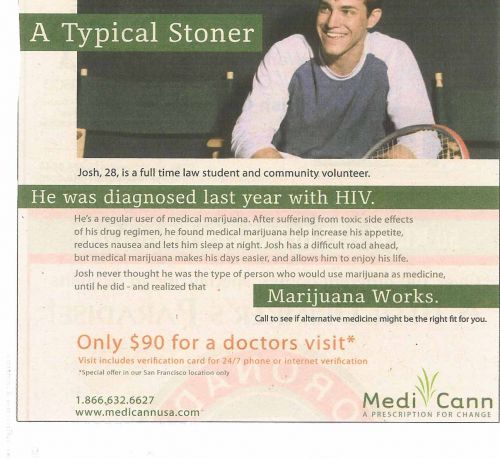
Cannabis goes mainstream... again


This headie advert comes your way via the Scene insert in this week’s San Francisco Bay Guardian. Lacking the ubiquitous pot leaf that adorns most medical marijuana advertising, the target audience here appears to be those for whom marijuana might not be an obvious choice. Imagine that: marketing marijuana as medicine.

Judge hands freedom to pot-hauling trucker

A Toronto area commercial trucker accused of smuggling 21 kilograms of pot across the Ambassador Bridge appeared to not believe his ears when a judge ruled Monday there was insufficient evidence for a conviction.

It took a few minutes before reality sunk in and Pius Idahosa, 36, realized he wasn't going to jail.

When it finally hit him outside Superior Court Justice Mary Nolan's courtroom that he was a free man, he struggled to a lobby chair before bursting into tears and sobbing loudly with relief.\

"Thank you, Jesus. She is an honest judge," he said of Nolan.

The judge had serious questions about parts of Idahosa's story but concluded the prosecution hadn't presented a solid enough case for conviction.

"Because I'm left with a doubt, I must give him the benefit of that doubt," said Nolan.

Canadian border agents discovered the large stash of baled pot, worth an estimated $206,000, in a hockey bag in the cab of Idahosa's rig on April 15, 2005.

Idahosa took the stand himself during his recent three-day trial and testified there were many drivers who had access to a number of keys to his truck, one of many similar-looking vehicles in his company's fleet. He said it had been left unattended over a two-day period, and the court heard the duffle bag with its well-wrapped contents had been in the truck for 10 days before the bust.

PROBLEMS WITH TESTIMONY

But the judge also noted problems with Idahosa's testimony.

Idahosa's last trip had been arranged by his company after he said he needed a route through Illinois to visit his sick aunt in a Chicago hospital.

After his request was accommodated, he said his aunt was no longer in hospital. Idahosa was unable to tell the court where his aunt lives or what hospital she was in.

The judge also wasn't satisfied with how Idahosa explained two $5,000 payments to his mother in Nigeria in the previous weeks to pay for a home.

Idahosa said it was proceeds from the sale of his Mercedes, but Nolan said the accused was "quite confused" when discussing his "unexplained wealth" and how he originally afforded that vehicle.

"She weighed all the angles," Idahosa said outside the courtroom after Monday's verdict. As defence lawyer Andrew Bradie exited the courtroom, Idahosa abruptly interrupted a cellphone conversation with his wife so that he could give him a big bear hug.

"Her honour gave a thoughtful and well-reasoned judgment. The Crown respects the decision of the court," prosecutor Richard Pollock said when asked whether an appeal would be considered.

e martë, 19 qershor 2007

Marijuana Law's U.S. History

Since the earliest settlers, marijuana has long been a cash crop in the United States. Many people, however, don't know how it became illegal. This is a brief history of the infamous weed.

1619: The first American law pertaining to marijuana, passed by the Virginia Assembly, required every farmer to grow it. Fibers from hemp, which is much less potent than the smokable kind, were used to make ship sails and rope.

1900-1930: Sailors and West Indian immigrants smoked marijuana in port cities along the Gulf of Mexico. In New Orleans, newspaper articles associated the drug with jazz musicians, prostitutes and the underworld. Police officers in Texas said marijuana "aroused a lust for blood" and gave its users "super human strength."

1931: Twenty-nine states had outlawed marijuana, generally with little fanfare or debate.

1936, "REEFER MADNESS": This propaganda film, originally financed by a church group and made under the title "Tell Your Children," is about what happens when teens try marijuana: a hit-and-run accident, manslaughter, suicide, rape and even a descent into madness. Soon after the film was shot, however, exploitation filmmaker Dwain Esper purchased the film, cut in several salacious shots and repackaged it under its now famous title.

1937, FEDERAL GROWING BAN: The Marihuana Tax Act passed, prohibiting Cannabis sativa -- the genus for the species of plant designated by Carl Linnaeus in 1753 -- from being grown. The legislation did not criminalize the use or possession of pot, but required anyone looking to grow marijuana to seek a tax stamp from the government. Failing to pay the tax resulted in fines up to $2,000 and five years in prison. The bill sailed through Congress, and only three lines were written on its passage in the New York Times.

BIRDSEED BROUHAHA: The one group to balk at the marijuana-growing ban was birdseed makers. They used hemp seeds in their bird feed, and to this day, because of an exemption, they are allowed to use sterilized seeds.

BEFORE 2000: Drug agents became better at spotting hidden crops from helicopters and planes. They combed through national forests and wetlands, known to be a fertile ground for illegal marijuana. Wildfires scorched growers' lands and sent their crops up in smoke. Poachers were such a problem that mild-mannered farmers placed punji boards, planks with upward facing spikes, around their fields. Criminal organizations installed armed guards.

POST-2001, TOUGH TO SMUGGLE: Smugglers found their jobs more difficult after Sept. 11 when the government beefed up its border patrol. Seizures mounted to more than 1 million kilograms. So, growers packed up their plants and hauled them inside because it was a good way to avoid detection, and produce, in controlled conditions, a more profitable product.

2005: According to a White House survey, there were more than 25 million marijuana users in the United States.

-- Compiled by Seth Robbins with News Researcher Karen Duffy contributing

It’s Okay to Like Pot.

Ask advocates why they want marijuana legalized and they will provide a variety of answers but rarely will they admit the obvious: they like marijuana.

It’s not that marijuana legalization advocates are ashamed of cannabis but that they’ve been trained to discuss the issue in the abstract by public interest groups who operate in constant fear of being labeled “pro-marijuana” or otherwise being tagged as promoting marijuana use instead of political reform.

Most of the public understand that many people use or have used marijuana without serious consequences for personal or public health. The public also understands that many marijuana users favor legalization because they like pot and don’t want to be arrested for it. It’s pretty obvious, and the public is skeptical of advocates who try to pretend otherwise.

When asked the question most advocates attempt to address the issue in terms of the public interest. The usual answers to the legalization question are in the 2nd person or 3rd person, as in here’s why you should want it legalized (2nd person) and here’s why society should want it legalized (3rd person). These answers, reasonable as they are, avoid the question. They are evasive, they avoid the 1st person response, as in why do I want marijuana legalized.

Here is an example of a direct, first person, answer: I want to be able to grow and use marijuana legally as an alternative to alcohol, and to do so I am willing to pay taxes, cooperate with a regulated market, support other drug control efforts, and promote socially responsible conduct.

People use marijuana for different reasons, and answers to the question will vary considerably. What’s important, though, is not so much the reason for wanting legalization but instead what one is willing to offer society in order to get it.

The legalization of marijuana will not be achieved through cleverness; it is not a matter of refining an argument or implementing a shrewd public relations campaign. Legalization is a political objective, and political objectives are accomplished through making deals, through an agreed upon exchange of actions. Deals, though, ultimately require trust ­ something marijuana users are quite familiar with. Honesty builds trust, and more honesty about marijuana use in the United States can only advance the cause of legalization.

Honesty about marijuana use reassures the public that marijuana does not have a high potential for abuse ­ indeed one of the symptoms of long-term use of a drug with a high potential for abuse is to avoid honest discussion about it. Honesty about the personal interest of advocates in legalization also builds credibility when it comes to the more important issue of socially responsible conduct. Politics is not only primarily a local phenomenon; it’s a personal one as well. This is as much a matter between ‘we the people’ as it is a matter between the people and their government. The latter struggle is often a matter of rights, but when it comes to deriving a social compact that provides the basis for a political consensus producing the legalization of marijuana it is a matter of discussing responsibilities and obligations rather than rights and entitlements.

Marijuana users are responsible individuals, and avoiding discussion of their interest in using marijuana also avoids opportunities to discuss their interest in being responsible citizens. The public is a lot more interested in responsible conduct than they are responsible use. Using drugs responsibly is a matter of self-interest far most of the public, they believe that if someone is careless enough to use drugs irresponsibly they deserve whatever trouble it causes.

Responsible conduct, though, is a different matter than responsible use. Certainly the public is interested in hearing about the impact of legalization on personal conduct involving such matters safety (driving under the influence) and restricted availability (not providing marijuana to teenagers and children). Many parents are just as concerned, though, about marijuana use in public ­ whether it is otherwise responsible use or not. The attitude of many parents can be generally summarized as “please, not in front of the kids” ­ underscoring their concern over the conduct of marijuana users over any concern for the effects on the users themselves. Most marijuana users view it as a private matter anyway, just as most marijuana users engage in responsible conduct whether they are stoned or not.

So, it’s okay to like pot, and if you want to argue in favor of marijuana’s legalization it’s okay to talk about your personal interest in this issue. Just remember there is a difference between one’s personal interest, the personal interest of others, and the overall public interest. Sounds complicated, but it’s not. It’s just a matter of offering the same respect for others that marijuana users should demand for themselves.

Arguments for legalizing marijuana should consist of two parts, why the advocate is in favor of it and why the audience should be. Advocates of marijuana legalization need to state both their personal interest in the issue and what actions they will take, personally, to address the audience’s interests. This serves the public interest because consensus is one of the results of this sort of compact-building approach.

You can’t begin work on a social compact, though, without first making it an issue for discussion. The best way to begin that process is for marijuana users to begin to address the issue in the first person, to claim a personal stake in the outcome of public debate over the marijuana laws, and to directly contradict the widespread misimpression that marijuana users are not socially responsible citizens.

Being direct about a personal interest in marijuana’s legalization, though, does not require an admission of past or present violations of the law. Note that the example above does not state “I use marijuana” or that “I have used marijuana illegally” but, rather, asserts that “I want to use marijuana legally.” Again, one has to look at it as a proposal, as a prospective deal ­ in the future I want to do this and I am willing to do this in return.

Everyone understands that many people now use marijuana illegally. That’s the point. Legalizing marijuana is not about validating that use; it’s not about saying it was okay for people to break the marijuana laws because it turns out there’s a better way to regulate it. Legalizing marijuana is simply about society adopting the better way, and what makes it a better way of regulation is the one thing that marijuana users have to offer in exchange for it ­ their cooperation in making regulation a more successful policy than the current prohibition.

The public is a lot more receptive to legalizing marijuana than ever before. It’s time for marijuana users to address the issue in the first person, it’s time for advocates of legalization to explain their personal stake in the issue, and it’s time to use honesty about marijuana use and social responsibility as a way to achieve legalization through building consensus rather than through inciting confrontation and divisiveness. It’s okay to like pot, but ultimately marijuana use is about consciousness, consciousness is about responsibility, and responsibility requires an honest compact between marijuana users and the rest of society.

420 Campaign - Top Ten Reasons Marijuana Should Be Legal

The readers of HIGH TIMES want marijuana legalized, nationwide, and now. The 420 Campaign is a plan to bring legalization before the US Congress and the public. We want to use April 20th as a focal point every year to concentrate pressure on Congress to legalize marijuana until we get the job done.

Here are our top ten reasons marijuana should be legalized:

10. Prohibition has failed to control the use and domestic production of marijuana.
The government has tried to use criminal penalties to prevent marijuana use for over 75 years and yet: marijuana is now used by over 25 million people annually, cannabis is currently the largest cash crop in the United States, and marijuana is grown all over the planet. Claims that marijuana prohibition is a successful policy are ludicrous and unsupported by the facts, and the idea that marijuana will soon be eliminated from America and the rest of the world is a ridiculous fantasy.

9. Arrests for marijuana possession disproportionately affect blacks and Hispanics and reinforce the perception that law enforcement is biased and prejudiced against minorities.
African-Americans account for approximately 13% of the population of the United States and about 13.5% of annual marijuana users, however, blacks also account for 26% of all marijuana arrests. Recent studies have demonstrated that blacks and Hispanics account for the majority of marijuana possession arrests in New York City, primarily for smoking marijuana in public view. Law enforcement has failed to demonstrate that marijuana laws can be enforced fairly without regard to race; far too often minorities are arrested for marijuana use while white/non-Hispanic Americans face a much lower risk of arrest.

8. A regulated, legal market in marijuana would reduce marijuana sales and use among teenagers, as well as reduce their exposure to other drugs in the illegal market.
The illegality of marijuana makes it more valuable than if it were legal, providing opportunities for teenagers to make easy money selling it to their friends. If the excessive profits for marijuana sales were ended through legalization there would be less incentive for teens to sell it to one another. Teenage use of alcohol and tobacco remain serious public health problems even though those drugs are legal for adults, however, the availability of alcohol and tobacco is not made even more widespread by providing kids with economic incentives to sell either one to their friends and peers.

7. Legalized marijuana would reduce the flow of money from the American economy to international criminal gangs.
Marijuana’s illegality makes foreign cultivation and smuggling to the United States extremely profitable, sending billions of dollars overseas in an underground economy while diverting funds from productive economic development.

6. Marijuana’s legalization would simplify the development of hemp as a valuable and diverse agricultural crop in the United States, including its development as a new bio-fuel to reduce carbon emissions.
Canada and European countries have managed to support legal hemp cultivation without legalizing marijuana, but in the United States opposition to legal marijuana remains the biggest obstacle to development of industrial hemp as a valuable agricultural commodity. As US energy policy continues to embrace and promote the development of bio-fuels as an alternative to oil dependency and a way to reduce carbon emissions, it is all the more important to develop industrial hemp as a bio-fuel source – especially since use of hemp stalks as a fuel source will not increase demand and prices for food, such as corn. Legalization of marijuana will greatly simplify the regulatory burden on prospective hemp cultivation in the United States.

5. Prohibition is based on lies and disinformation.
Justification of marijuana’s illegality increasingly requires distortions and selective uses of the scientific record, causing harm to the credibility of teachers, law enforcement officials, and scientists throughout the country. The dangers of marijuana use have been exaggerated for almost a century and the modern scientific record does not support the reefer madness predictions of the past and present. Many claims of marijuana’s danger are based on old 20th century prejudices that originated in a time when science was uncertain how marijuana produced its characteristic effects. Since the cannabinoid receptor system was discovered in the late 1980s these hysterical concerns about marijuana’s dangerousness have not been confirmed with modern research. Everyone agrees that marijuana, or any other drug use such as alcohol or tobacco use, is not for children. Nonetheless, adults have demonstrated over the last several decades that marijuana can be used moderately without harmful impacts to the individual or society.

4. Marijuana is not a lethal drug and is safer than alcohol.
It is established scientific fact that marijuana is not toxic to humans; marijuana overdoses are nearly impossible, and marijuana is not nearly as addictive as alcohol or tobacco. It is unfair and unjust to treat marijuana users more harshly under the law than the users of alcohol or tobacco.

3. Marijuana is too expensive for our justice system and should instead be taxed to support beneficial government programs.
Law enforcement has more important responsibilities than arresting 750,000 individuals a year for marijuana possession, especially given the additional justice costs of disposing of each of these cases. Marijuana arrests make justice more expensive and less efficient in the United States, wasting jail space, clogging up court systems, and diverting time of police, attorneys, judges, and corrections officials away from violent crime, the sexual abuse of children, and terrorism. Furthermore, taxation of marijuana can provide needed and generous funding of many important criminal justice and social programs.

2. Marijuana use has positive attributes, such as its medical value and use as a recreational drug with relatively mild side effects.
Many people use marijuana because they have made an informed decision that it is good for them, especially Americans suffering from a variety of serious ailments. Marijuana provides relief from pain, nausea, spasticity, and other symptoms for many individuals who have not been treated successfully with conventional medications. Many American adults prefer marijuana to the use of alcohol as a mild and moderate way to relax. Americans use marijuana because they choose to, and one of the reasons for that choice is their personal observation that the drug has a relatively low dependence liability and easy-to-manage side effects. Most marijuana users develop tolerance to many of marijuana’s side effects, and those who do not, choose to stop using the drug. Marijuana use is the result of informed consent in which individuals have decided that the benefits of use outweigh the risks, especially since, for most Americans, the greatest risk of using marijuana is the relatively low risk of arrest.

1. Marijuana users are determined to stand up to the injustice of marijuana probation and accomplish legalization, no matter how long or what it takes to succeed.
Despite the threat of arrests and a variety of other punishments and sanctions marijuana users have persisted in their support for legalization for over a generation. They refuse to give up their long quest for justice because they believe in the fundamental values of American society. Prohibition has failed to silence marijuana users despite its best attempts over the last generation. The issue of marijuana’s legalization is a persistent issue that, like marijuana, will simply not go away. Marijuana will be legalized because marijuana users will continue to fight for it until they succeed.

The FDA and Medical Marijuana

The Food and Drug Administration (FDA) scored a public relations coup on April 20th with a one-page news release that merely restated longstanding administration policy regarding the medical use of marijuana. This old news was packaged by the media as new news, and much of the coverage reinforced the misimpression that FDA’s release reported the results of some recent investigatory process. The good news, ignored by the media and most of the movement, is that a current FDA review of marijuana’s medical properties remains underway.

In fact, the “Inter-Agency Advisory Regarding Claims That Smoked Marijuana Is Medicine” plainly stated that it was based on “a past evaluation by several Department of Health and Human Services [HHS] agencies.” One such evaluation, and the likely evaluation referred to in the advisory, took place in response to my 1995 rescheduling petition. This HHS/DEA evaluation was flawed in several respects, including its failure to even address the issue of accepted medical use. The evaluation of the 1995 petition, frequently used to provide a scientific justification for marijuana’s ongoing schedule I status, was never subjected to judicial review, and by no means represents closure on the issue of marijuana’s medical use.

Indeed much has happened since the 1995 rescheduling petition, including the filing of an updated and advanced rescheduling petition in 2002. The 1995 petition relied on scientific literature regarding marijuana’s potential for abuse. The 2002 petition, though, focuses more concisely on the issue of accepted medical use and the presentation of relevant scientific and medical evidence was enhanced by the contributions of a number of experts. Background materials on both rescheduling petitions are available at http://www.drugscience.org.

The current rescheduling petition was referred by the Drug Enforcement Administration (DEA) to HHS in the summer of 2004 for a complete scientific and medical evaluation, as required by the Controlled Substances Act. This HHS review is currently underway, and is being conducted, in part, by the same Food and Drug Administration that issued the news release that past evaluations have found that smoked marijuana is not medicine. Please note now, for the record, that FDA’s 4/20/06 announcement neglected to mention that the agency is currently conducting a new evaluation of whether or not marijuana’s medical use has been accepted in the United States – the evaluation of the 2002 rescheduling petition I filed along with the Coalition for Rescheduling Cannabis.

The federal government has long held, as a matter of legal and regulatory doctrine, that - for the purposes of regulating drugs under the Controlled Substances Act - nothing is medicine unless the DEA says it is medicine. In more precise terms, the DEA argues that accepted medical use under the Controlled Substances Act requires FDA approval of a drug under the provisions of the Federal Food, Drug, and Cosmetic Act. The problem with this argument is that it has already been struck down by the US Court of Appeals in NORML v. DEA (1977). The Appeals Court ruled that recognition of accepted medical use for the purposes of scheduling under the CSA does not require prior FDA approval of medical use.

Let’s pause for a second and make this simple. The government (DEA, FDA, etc) argues that marijuana is not medicine because they say it is not medicine. The courts, though, have a different opinion on the matter. When it comes to how the Drug Enforcement Administration regulates drugs under the Controlled Substances Act the government’s job is to determine if a drug has accepted medical use. That means accepted by medical and scientific professionals, not accepted by the DEA.

When it comes to assessing whether or not marijuana has accepted medical use in the United States both DEA and the FDA have a legal obligation to assess whether it has been accepted by health care and medical professionals as well as to assess the scientific evidence recognized as valid by those professionals.

Which brings us back to the current review being conducted by HHS and FDA – the current review of the 2002 CFR rescheduling petition must consider all available scientific and medical evidence. They can’t rely on their flawed “past” evaluations to reject the evidence in the current petition and in the contemporary scientific record.

When the current review is complete HHS will return the rescheduling petition to DEA. The CSA authorizes DEA to collect any additional relevant information at that time. When DEA is finished adding what it wishes to the official record the agency’s decision will be published in the Federal Register and subjected to public comment. At that time people affected by the DEA’s decision can seek review of matters of fact by an administrative law judge or judicial review of matters of law by the U.S. Court of Appeals.

Meanwhile the review of marijuana’s medical use by the scientific staff at FDA continues, regardless of the pronouncements of the public affairs office and perhaps, even, in spite of it. Let’s not rush to judgment on the topic of the FDA and medical cannabis. We know what the political and public affairs staff of the agency thinks about the subject, but let’s wait and see what the scientists now evaluating the CFR petition have to say on the matter before making a final assessment about the FDA’s dedication to science and the public policy process.

Marijuana Production in the United States (2006): The Nation’s Largest Cash Crop

The most recent and compelling report on US marijuana production reveals that not only is cannabis now the largest cash crop in the United States but also that, according to US Government data, domestic marijuana cultivation has grown ten-fold over the last 25 years.

This new report on marijuana production was recently published in the Bulletin of Cannabis Reform and distributed to the national media by the Marijuana Policy Project. In 2006 domestic marijuana cultivation was worth $35.8 billion, more than corn and wheat combined. Over 56 million marijuana plants were cultivated outdoors with a value of $31.7 billion and 11.7 million plants were cultivated indoors at a value of $4.1 billion.

"The fact that marijuana is America's number one cash crop after more than three decades of governmental eradication efforts is the clearest illustration that our present marijuana laws are a complete failure," said Rob Kampia, executive director of the Marijuana Policy Project in Washington, D.C. "America's marijuana crop is worth more than our nation's annual production of corn and wheat combined. And our nation's laws guarantee that 100 percent of the proceeds from marijuana sales go to unregulated criminals rather than to legitimate businesses that pay taxes to support schools, police and roads."

Legalization would change all that by transforming marijuana producers from criminals under current laws to responsible merchants operating under state and federal regulations. Perhaps of greater interest to marijuana users is that legalization would significantly lower the cost of marijuana to responsible adult users and eliminate much of the profit incentives that are responsible for the availability of marijuana to teenagers and younger children.

Since the NORML Foundation published the last report on domestic marijuana production in 1998 new evidence has surfaced that clearly establishes the magnitude of marijuana cultivation in the United States. Despite intensive eradication efforts over the last 25 years the federal government has recently acknowledged that domestic marijuana production has increased from 1,000 metric tons (2.2 million pounds) in 1981 to 10,000 metric tons (22 million pounds) in 2006.

The new crop report derives a price index from extensive data from the National Survey on Drug Use and Health to establish a price of $1,606 per pound at the producer level and utilizes modest yield estimates of 200 grams for outdoor plants and 100 grams for indoor plants (these figures are considerably lower than common police estimates of a pound per plant and values $2,000 to $4,000 per pound) establishing the overall value of $35.8 billion as both conservative and credible.

The top ten marijuana producing states are California, Tennessee, Kentucky, Hawaii, Washington, North Carolina, Florida, Alabama, West Virginia, and Oregon. Five states (California, Tennessee, Kentucky, Hawaii and Washington) had marijuana crops worth over $1 billion.)

Marijuana is now the top cash crop in 12 states, one of the top 3 cash crops in 30 states, and one of the top 5 cash crops in 39 states. Domestic cannabis is a larger cash crop than cotton in Alabama, larger than grapes, vegetables, and hay combined in California, larger than peanuts in Georgia, and larger than tobacco in both South Carolina and North Carolina. The Bulletin of Cannabis Reform’s special report also contains extensive tables of marijuana production and detailed comparisons of marijuana and other cash crops by state.

This new report argues that the government's failure to reduce the growth of marijuana leaves marijuana's legalization as the only reasonable option left for policymakers to control this untaxed and unregulated market. It’s time to debate the legalization of marijuana in the United States. Key elements of marijuana legalization policies should include federal and state excise taxes on production, distribution, and sales along with licensed market participation, age restrictions, and prohibitions on advertising and marketing to minors. Current regulatory models for tobacco and alcohol provide suitable examples upon which to base legislation to enact effective marijuana controls under federal and state laws. The ten-fold growth of production over the last 25 years and its proliferation to every part of the country demonstrate that marijuana has become a pervasive and ineradicable part of our national economy.

In addition to this report on marijuana production, the Bulletin of Cannabis Reform also includes the Drug Enforcement Administration's reports on marijuana eradication from 1982 through 1993, along with yearly tables of eradication statistics of both cultivated marijuana and ditchweed (wild hemp) from 1982 through 2005.

The federal government’s admission that marijuana cultivation has grown ten-fold over the last 25 years is a powerful argument in favor of marijuana’s legalization. It is tacit recognition that the eradication and prohibition efforts have not only failed to suppress marijuana production, but have actually transformed it into the largest cash crop in the United States. This in spite of, as the report details, being well funded, having tremendous local cooperation, sophisticated technology, the help of the National Guard, and authority to seize considerable assets. Even these advantages have not enabled the government to exercise control over marijuana cultivation in the United States. For example, a report by the Federal Research Service of the Library of Congress suggests that at best law enforcement seizes just 10% of the marijuana available in the country. Another indication of the futility of current policies is that marijuana cultivation has spread from just California and Hawaii in 1979 to every state in the nation.

Marijuana Production in the United States (2006) provides valuable information and arguments for advocates of marijuana’s legalization. It’s a must read for local activists, advocates for reform, and policymakers at the state and federal level. If you want to give your congressional representatives and US Senators a good reason to take a fresh look at marijuana’s legalization, this is the report you should bring to their attention. Look over the information provided in HIGH TIMES' 420 Campaign, use that information to contact your representatives in the US Congress, and encourage them to review this new report on marijuana production in the United States.

A Record Number of Americans Favoring Marijuana’s Legalization Provides Historic Opportunity to Build Majority Support

A majority of Americans do not support the legalization of marijuana, but survey data indicates that over the last twenty years support for legalization has been steadily growing.

The Sourcebook for Criminal Justice Statistics provides data on public attitudes about marijuana’s legalization in the form of summary tables from several national surveys. These tables provide detailed information regarding support for legalization by age, sex, education, income, region of the country and political affiliation; they provide solid proof of both the progress the marijuana reform movement has made in recent years as well as the challenge that remains for supporters of legalization.

For the first time in decades in 2005 a majority of Americans (55%) opposed criminal penalties for marijuana use, an increase from 46% in 1985 and 47% in 2000.

Support for marijuana’s legalization, as measured in 2005, stands at 36%, the highest ever. In 1969 only 12% of Americans favored legalization, by 1977 that had increased to 28%. In 1979 support for legalization fell to 25% where it more or less remained through 1995. But with an increase in marijuana arrests throughout the 1990s and the advent of medical marijuana reform in California in 1996 public opinion began to reflect the realization that prohibition just wasn’t worth the costs and as a result, support for legalization began to increase. By 2000 support for legalization had increased to 31%, for 2001 and 2003 support stood at 33%, and then reached a new record high at 36% in 2005.

Support for legalization fell steadily among college freshmen from 51.3% in 1977 to 16.7% in 1989, but since then legalization has steadily gained support from first year college students. By 1992 legalization was supported by 24.8% of college freshmen, by 1996 legalization support had increased to 32.4%. In 2005 marijuana’s legalization was supported by 37.7% of college freshmen.

A 2002 poll showed that support for legalization was stronger among males (38%) than females (30%) and among whites (36%) than blacks (24%). Legalization support is strongest among 19-20 year olds (59%) and decreases with age, with only 41% of people age 21 to 29 supporting it, 38% age 30 to 49, and 24% of those 50 and over.

Legalization support is strongest in the West (45%) and weakest in the South (27%), and, interestingly, more popular in the Midwest (38%) than in the Northeast (29%). Legalization also has more support from those whose religion is Jewish (60%) than Catholic (30%) and Protestants (26%). Politically, legalization has the greatest support from Independents at 39% compared to 34% of Democrats and 24% of Republicans.

The medical use of marijuana, though, has overwhelming support from all Americans. When asked in 2005 "Would you favor or oppose making marijuana legally available for doctors to prescribe in order to reduce pain and suffering?" 78% of Americans said they favored the legal use of marijuana for these medical reasons, an increase from 75% in 2003. In 2003 over 64% of every demographic group considered expressed support for medical use.

Recent reports on the failure of marijuana arrests and marijuana eradication efforts to reduce the use and availability of marijuana provide clear and convincing evidence that marijuana prohibition is a failing and costly policy. The failure of marijuana prohibition and changing public opinion provide additional justification for HIGH TIMES’ editorial position supporting marijuana’s legalization as the number one priority of reform efforts.

The long term trends in public opinion suggest that the next few years will provide a historic opportunity to build majority support for legalization, providing a chance to build support for legalization among both Democrats and Republicans in the Congress and among the emerging field of candidates in the 2008 presidential elections. For all these reasons and more now is the time to participate in HIGH TIMES’ 420 Campaign and embrace the 420 strategy for legalization. Learn who your state and federal legislators are, contact them now, on April 20th, and several times in the future and let them know of your support for marijuana’s legalization.

Support for legalization is growing, but in order for this growth to continue it is important for the public and for political leaders to learn more about the failures of prohibition and to frequently hear from supporters of legalization in every part of the country. One of the reasons the reform movement has been more successful in the last 10 years has been its diversity and its efforts to reach out to more of the country through different organizations and a broad range of activities and projects – all of which amplifies the central message that marijuana’s legalization is good for the country. Now is the time to take advantage of that progress and make your voice heard. The poll numbers indicate that it is still a challenge to build majority support for legalization, yet it is a challenge not only worth meeting, but one that the movement is well on its way to achieving.

Why Pot Remains Illegal

Marijuana cultivation, possession, and use remain illegal in the United States because the public wants it that way, and they will continue to support prohibition until advocates convince them to change.

Public opinion is changing, but it has not changed enough to cause politicians and legislators to make legalization occur.

Sure, there are lots of powerful arguments why legalization is in the public interest. Many of these arguments offer promising tools with which to persuade the public and political leaders to support marijuana’s legalization. They indicate that there are sufficient factors and conditions in the United States for marijuana to be legalized. The big question, though, is what conditions are necessary for legalization? The answer, obviously, is widespread public support.

Many marijuana users are reluctant to become politically active in support of legalization. Many more, though, are committed to political action and support reform efforts in a number of ways, including contacting legislators, participating in public debate, writing letters to the editors of newspapers, providing financial support to reform organizations, participating in political campaigns, writing articles, conducting research, and organizing local community action groups. Tens of thousands of marijuana users and supporters are politically and socially active across the United States and are responsible for tremendous progress in the marijuana reform issue over the last two decades.

But many marijuana users are still reluctant to become active in this national movement to bring about legalization. Some just don’t know how to get involved or just what they can do to help. All they need to do, though, is get involved in any of the various projects designed to increase public participation in support of marijuana reform, such as the HIGH TIMES 420 Campaign or the activities of NORML, MPP, or other public interest reform organizations.

Others who are not yet involved in the reform movement are still a bit afraid that political action will make them vulnerable to arrest and/or other forms of punishment. Indeed, one of the objectives of national policy about marijuana use is to threaten marijuana users with various sanctions and penalties in order to discourage both marijuana use and political participation. It’s no coincidence that the DEA’s website contains material against marijuana use and its legalization, and that drug testing for marijuana use is still promoted across the United States. However the marijuana reform movement is not only a political movement, it is a social movement that provides support and assistance for marijuana users throughout the country.

The overall campaign to suppress marijuana use can only be resisted through building and relying on a supportive community dedicated to reform, justice, and political change, and in this respect the marijuana reform movement is an example of active resistance to prohibition in every sense of the word. One of the goals of efforts to suppress marijuana use is to create isolation among users, the marijuana reform movement, a counterculture in name and deed, combats that isolation through community development.

Still, many marijuana users who are not active in reform activities hide behind a common excuse in one form or another. They argue that marijuana will never be legalized and therefore there is no point in fighting back. Some claim that the government makes too much money from prohibition and they will never allow change, others argue that the pharmaceutical companies will lose too much money from legalization. These are the worst kind of excuses for not being involved in reform activity because they represent a total surrender of freedom and an utter lack of faith in our democratic society. It doesn’t matter why marijuana is illegal, and there are certainly a lot of interesting theories on this subject. What matters is that the citizens of the United States have the power to make marijuana legal, no matter who may oppose this revolutionary change in our laws and society. The choice, for individual marijuana users and supporters of legalization, is simple: surrender to injustice, or fight for freedom!

Marijuana remains illegal because the public is, as yet, unconvinced that legalization is best for the public interest. Marijuana remains illegal because the supporters of legalization have failed, so far, to make legalization appeal to a majority of the public. It doesn’t matter how hard law enforcement works to oppose legalization, nor does it matter how hard the supporters of prohibition work to keep it in place. It doesn’t matter how much the opponents of marijuana’s legalization distort the scientific record or mislead the public, nor does it matter how much money various interests make by keeping marijuana illegal. All of these factors may be sufficient to keep marijuana illegal, but none of them make prohibition a necessity. The most important factor that will determine if marijuana is legal or not is how many people are willing to work socially, politically, and financially for legalization until it is achieved.

Increasing public involvement in reform efforts and convincing the public that legalization is in their interest is what is required to make marijuana’s legalization a political and economic necessity in the United States.

The 7 Skills You Need to Make Legalization Happen

If you want marijuana legalized, you’ll have to ask for it. Legalization is not something to wait for, nor is it something that will be delivered to you by a few public interest groups. If you want it, then you’ll have to do something about it. The path to marijuana’s legalization begins within your own life. What can you do to make legalization a reality? While the cause itself is complex the ultimate answer is fairly simple. Develop your own power as a citizen and as a voter. Here are seven important skills that will enhance your influence on the political system in this country.

These seven skills will increase your power as a voter. But before you even consider how to increase your power as a voter you have to first establish your status as a voter and a participant in our political system. Here is a guide to finding out who your legislators are and what legislative districts you live in. It includes links to every state legislator, access to maps of legislative districts, and links to look-up services to identify your legislators.

Every supporter of marijuana’s legalization needs to a) know which legislative districts they live in, b) register to vote, and c) vote regularly. Those three activities are the source of your power as a voter as they make you a "likely voter". In other words, those three simple activities make politicians, legislators, their staffs, and public opinion polls pay more attention to you and treat you with respect. Those activities are the source of power and influence for voters.

These seven skills will help you increase that power and use it to bring about the legalization of marijuana.

1) In your own words. It is the common practice of lobbying groups to provide supporters with sample letters to send to legislators. This is a convenient and effective practice, and it is standard procedure any time an important matter is before a legislature. Learn to write your own letters. It's not hard to learn the format, and there are plenty of opportunities to get helpful tips and to practice. These are simple skills to acquire and valuable in many other areas of life. Get some experience writing to your legislators on some routine matters, such as asking them about their priorities for the coming session. Every congressional representative is up for election every two years, so, for example, this next two months is a great time to contact them and find out where they stand on legalization and why.

2) Do what you do. You don't need to become the perfect citizen activist to contribute to the legalization of marijuana. We live in a diverse and complex society. Social and political change of this nature requires diverse contributions and activities to persuade these diverse networks to support legislative efforts to bring about marijuana's legalization. If you are a student then you can further legalization by studying the issue. If you are a graphic artist then you can further legalization by creating ads, posters, and other graphic tools that enhance communication and social understanding of this cause. If you work with new technologies then you can contribute to legalization by applying those technologies to efforts to reach and persuade different social groups to support legalization. Not only should you support legalization in your own words, you should support it in your own way. If you do what you do then your example will inspire your friends and colleagues in ways the rest of us can't even imagine.

3) Play against type. The stoner stereotype is just an excuse to ignore young people. Think about it. Even when it's applied to someone middle-aged the real accusation is that the 'aging hippie' never grew up. Adults get frustrated with teenagers and young adults from time to time, and when they go off on a little rant it's usually about how "kids" aren't focused, lack manners, wear strange clothes, use odd language, lack respect for their elders, have no ambition and are probably damaging their health with the latest fad. The stoner stereotype is just an exaggeration of these age-old complaints about the young. So another source of power is learning how to do things right and showing off that you know how to behave more effectively than many people twice your age. Young people are smart, creative, ethical, values-driven, and hard-working. Use those traits to your advantage.

4) Be the customer. We live in a consumer society where customers are treated, more often than not, with respect. Contrary to the popular saying the customer is not always right, but the vendor who doesn't listen to a customer is always wrong. Successful legislators understand this and constituent service such as answering questions and providing help with government agencies is a well-known key to re-election. Responding to customers is also a popular practice for many businesses. People enhance their power as consumers when they learn how to make effective complaints. Many of the procedures for complaining about service in everyday life are also effective for communicating with legislators. Think about the format of a successful complaint: here are the facts, here's why this was wrong or unacceptable, and here's the remedy I think is justified under the circumstances. It may be that your meal was late and you deserve a free desert, or that your car wasn't repaired and you deserve a free tow back to the garage. Remember that legislators are your representatives; it's their job and the job of their staffs to provide you with service. It's their job to treat you like a customer or client.

5) Stay positive. You don't advance the cause of legalization by focusing on all the reasons marijuana is illegal. Treating legalization like a lost cause guarantees that it will never take place. It's very easy to come up with a list of reasons why marijuana will never be legalized. But all that does is discourage people from focusing on why legalization will take place. Critical thinking is an important part of staying positive. The goal is to imagine feasible ways marijuana will become legal and then use critical thinking as part of the work required to make it happen. There are a lot of nasty realities woven into the tapestry of prohibition, but we have to transcend that with a positive vision of change to motivate the natural supporters of marijuana's legalization.

6) Develop memory. Make notes, keep records, build files. Maybe that's not you. Just keep the replies you receive via email or letter from any public official you contact. They become very helpful when you write them again in the future. For example, a legislator might argue that they oppose marijuana's legalization for a list of reasons. It is effective to refer and respond to that list of reasons in a reply of your own. It is also effective to remind legislators of their past positions and hold them to them. A legislator may defend his/her opposition to marijuana legalization because they are concerned about the threat of lung cancer. Recent research suggests that marijuana smokers have a low risk of lung cancer, providing an opportunity to respond to this concern and eliminate it as a hurdle to legalization. Developing support for legalization is as simple as making a list of reasons against it and refuting them one by one. Of course legislators don't always respond to individual arguments from constituents. That's why it' necessary to develop skills to make effective use of one's power as a voter. Over time legislators are influenced by contact from constituents, especially as they hear from more and more people, in their own words, advocating different approaches to stubborn issues. Developing memory helps make communication with legislators a productive discussion focused on reasonable disagreements over the issues.

7) Work the system. Would you rather let the system work you? You enhance the effectiveness of all of these skills by learning how the system works and using that knowledge to your advantage. There's no mystery to getting legislatures to change laws. It may be difficult to accomplish, but the process itself is plain to see and easy to understand. You don't need experts to tell you what to say, how to act, and how some plan is going to succeed. It's simple enough. We have a political and social system. We learn procedures and make them work for us everyday, whether we're ordering lunch, learning how to use new software, getting a drivers' license, or registering for a class. Changing laws has its own set of procedures. The more you understand them the more effective you will be at using your power as a voter. The starting point, though, is the set of three fundamentals introduced at the beginning of this article: you need to know which legislative districts you live in, register to vote, and vote regularly. The next step in working the system is to develop communication skills and use them to develop relationships with your legislators at both the state and national level.

These seven skills are vital to the success of efforts to legalize marijuana in the United States. These skills empower individuals to become an effective force for change through the use of their fundamental rights in our democratic system. Use these skills to become a strong independent and effective voice for marijuana's legalization in the United States. HIGH TIMES is always working on new ways to support the cause of marijuana’s legalization, and will continue and expand its efforts to help you use these skills to develop your power as a voter.

Lets make legalization a priority, now, for both the movement and the nation.

Marijuana Facts

  1. Of the 200 million drug users, 163 million prefer cannabis.
  2. In two thirds of all countries, cannabis production and use has increased over the past year.
  3. The first and second drafts of the Declaration of Independence were written on hemp paper.
  4. J.F Kennedy planned to legalise cannabis in his second term.
  5. In 1941 Ford created a car fueled by cannabis.
  6. Jimi Hendrix, Abbie Hoffman and the Yippies once mailed out 3000 joints to random New York addresses.
  7. Elizabeth I ordered all landowners with over 60 acres to grow cannabis or face a £5 fine.
  8. Paul McCartney spent 10 days in a Japanese prison for possession.
  9. The Father of Chinese medicine (Shen Nung) calls it a 'superior' herb.
  10. Mohammed permits cannabis use but forbids alcohol.

e hënë, 18 qershor 2007

Genetically modified marjiuana

Welcome to the future.

A random google search turned up this discussion. Is this news? Apparently, at least one person has been performing experiments, to genetically modifying marijuana.

I have started a new identity here on OG to give you guys a heads up to the research I am doing.

I am no newby to Overgrow or growing in general. I am Canadian and have a solid backround in DNA properties and manipulation.

First I would like to say that ALL the research I am doing is out of my own pocket. I am not being paid for my time, I am using my lab and all the equipment within. Let me stress I am doing this out of MY OWN wallet. Trust me, a couple microliters of restriction enzyme can run a pretty penny.

Genetic modifications are become very common. Since cannabis is an illegal substance, it is not getting the attention that it should. There is research and development being carried out, but it is not to the end that will benifit the recreational user. These studys are however serving as reference for my work

There are two really interesting things going about this.

The first is that someone is that genetic modification has become so easy and commonplace that some educated and well situated people are in the position to do some of their own, purely for there own entertainment.

The second is that perhaps a little less obvious, and that is that information and knowledge is idly being transfered and dissected on a web bulletin board. I’ve seen similar things going on in other forums, but geneticly modifying plants?

But what’s next?

I am in complete research mode right now. I have the basis for two experiments and am currently researching more indepth into how to adapt the procedures for cannabis.

The one that looks the most promising is to overexpress the enzyme THCA synthase. This enzyme catalyzes a dehydrogenation reaction of tetrahydrocannabinolic acid to THC (see pic).

I am trying to characterize the regulation sequences of THCA-synthase and modify them so that the enzyme is produced in the largest quantity it can be. I would like to change the sequence of the promoter to make it so that the RNA polymerase will bind the DNA more often thus making more messenger RNA.

If there is an abundance of mRNA that will be translated into an abundance of THCA-Synthase. HOPEFULLY, more enzyme will equal more THC content..

He’s definitely not alone, and this didn’t just happen. The discussion in question started back in 2002.

What’s more, the government has been doing this a lot longer. All government created weed, used for the creation of marinol as well as the few research projects that are permitted are genetically modified.

In order to create sterile plants for medical marijuana and government santioned experiments, Monsanto was recruited to use their ‘grandfather’ gene process - that creates fertile plants with infertile children - so that plants could be created without fertile seeds being distributed. Heaven forbid viable plants from a government source should fall into the hands of your local stoner. Let’s forget about the fact that viable seeds are available from all sorts of places already. (This was Monsanto’s first genetic creation, and at the heart of their business model. Why create frankentomatoes if you can’t have a monopoly on the seeds.)

However, apparently Monsanto is not only creating sterile plants, but deliberately creating low potency strains under governmental guidelines: pharmaceutical schwag.

Cannabis seeds from Monsanto are almost definitely genetically engineered. Genetically engineered plants can be patented, and it is in Monsanto’s best interest to hold a patent on any seed they sell. Seed patents ensure that companies like Monsanto can continue to profit from seeds from year to year, as farmers are legally bound to buy patented seeds from the patent holder rather than simply store them from the last year’s crop.

Interestingly, low-potency pot of the kind produced by Monsanto seeds at the University of Mississippi is exactly the kind of product the Ministry of Health is asking for from contractors. The guidelines ask specifically for “standardized marijuana cigarettes with THC content of between 4% and 6% and weighing [about] 850 mg.”

Which means the cigarettes to be used for clinical trials will be phatties containing over three-quarters of a gram of schwag bud each! These fat joints will deliver about twice the tar per dose as marijuana currently available from experienced growers, which reaches between 8-10% THC.

So, there you have it. Genetic engineers creating super potent weed strains is rather difficult to reconcile with the concept of weed being a mentally debilitating substance. And, the government is burning your money on high tech solutions to non existent problems.

But, I think, to the average stoner, this is probably better than jet boots and flying cars combined. We are living in the future. Genetically modified weed! Genetically modified weed!